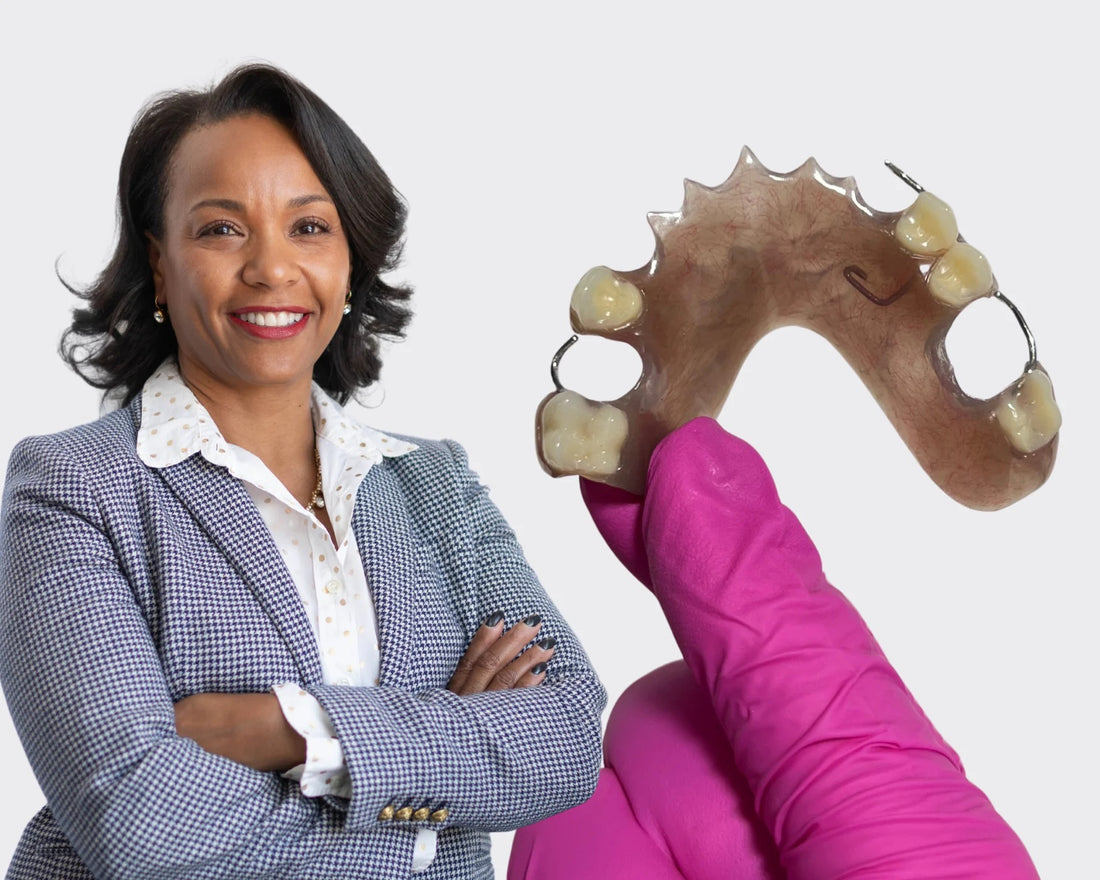
Types of Removable Partial Denture, With Price, Turnaround and Material for Each
Share
Five removable partials come off one bench here, from $399 for one arch to $1,498 for both, and each one is a different answer to the same question of how many teeth are gone. The gap picks the type far more often than taste does.
Five types in one table
| Type | Material | One arch | Both arches | Built in | Teeth it carries |
|---|---|---|---|---|---|
| Acrylic partial | Rigid acrylic | $469 | $619 | 6 to 10 business days | Up to six |
| Flexible nylon | Injected nylon | $399 to $649 | $699 to $1,049 | 6 to 10 business days | Two to eight |
| Two to five teeth | Injected nylon | $549 | $949 | 6 to 10 business days | Two to five |
| Six to eight teeth | Injected nylon | $649 | $1,049 | 6 to 10 business days | Six to eight |
| Cast metal | Cast metal frame | $749 | $1,498 | 6 to 10 business days | Two to eight |
Every price already holds the mold kit, the postage in both directions and 30 days of adjustments.
A plate bought off a shelf is a plate on its own, with no mold of your arch behind it and no adjustment window after it lands. Both sit inside the numbers above.
What a removable partial is, and where the line with a flipper runs
A removable partial is a plate that carries replacement teeth and clasps on to the teeth you still have. It lifts out in a second, nothing is drilled to make room for it, and it seats the same way every time.
The line with a flipper is about width rather than about quality. Up to three teeth in a row, with your own teeth standing on both sides of the gap, is a flipper at $319.
Four and more gone on the same arch and the plate has to be wide enough to stay put, and that is where a partial begins. The three flippers sit on the flipper page.
Losing another tooth later does not mean starting over. Upgrading a flipper to a partial is $200 from the mold we already hold on file.
Acrylic partial, $469 to $619
A firm poured plate with small metal clasps hooked over the teeth beside the gaps. It carries up to six replacement teeth on one arch and it is the least you can pay us for a whole arch. Six to ten business days at the bench.
What you give up for the price is visibility. The clasps sit behind the smile line wherever the case allows it, but acrylic is rigid, so it is the thickest of the three against the palate and the one a clasp can show on.
Acrylic is also the one that snaps when it lands on tile, and that is the honest weak spot of the cheapest build. A fault in the build is ours to redo inside 60 days. A drop is not, which is why the case it ships in is worth using every night.
Flexible nylon partial, $399 to $1,049
Nylon is injected rather than poured, and it carries no metal clasps at all. The base is gum toned, so it disappears against your own gum instead of drawing a line across it, and nothing crosses the front of your smile.
It is also thin. Most people stop feeling its edge inside the first week, which is the main reason it is the one worn longest out of the five.
What you pay for that is a higher price than acrylic and a base that flexes rather than staying rigid. Under heavy chewing a cast metal frame does more.
Flexible bridges and the cast metal framework, $549 to $1,498
The two fixed count flexible builds are the same nylon with the price settled up front. Two to five teeth is $549 an arch and six to eight is $649. When you already know the count and it is not going to move, a fixed price beats an open range.
The cast metal framework goes the other way entirely. The frame is cast thin, so it covers far less of the palate than a plate of acrylic, and it takes the most chewing of the five. Six business days at the bench, $749 for one arch and $1,498 for both.
On the lower arch there is no palate to spread the load across, so a thin cast frame sits where a wide acrylic plate would mostly be in the way of your tongue. That is why the metal build is ordered for the bottom more often than for the top.
The two types we do not make, and why
An implant supported partial anchors on posts placed in the jaw. The surgery, the healing and the fitting all happen in a chair, and no part of that arrives in a box.
A fixed bridge is cemented onto the teeth either side of the gap after they are prepared for it. Once that enamel is shaped the decision does not come back, and that is a call for the clinician who is doing the preparing.
We are not going to put a price on either of them, because we do not sell them and we hold no figure we could stand behind. What can be said plainly is that both start with a visit and neither one comes out at night.
Three questions that pick the type for you
- How many teeth are gone. Up to three in a row is a flipper, two to eight on one arch is a partial, and the count decides which flexible build you land in
- Are there teeth on both sides of the gap. With your own teeth on both sides almost any of the five holds. With the gap running off the end of the row the plate has to reach further, and that is where cast metal earns its price
- Does weight matter more than invisibility. Cast metal is the thinnest and the strongest, nylon is the one nobody sees, acrylic is the one that costs least
Still between two of them, send a photo of the arch with the order and a technician will say which one the case actually calls for.
How long each type lasts and what kills it
The honest measure is the warranty rather than a number of years. 60 days covers the build itself, 30 days covers the fit, and a remake for the same reason costs nothing.
What kills each one is different. Acrylic goes on a drop onto tile and on household bleach. Nylon goes in boiling water, because heat is what pulls an injected base out of shape. A cast frame is the hardest of the three to break, but a clasp bent by being forced on will stop holding the way it did.
The routine that prevents most of it is the same for all five. Rinse after meals, brush gently with a soft brush and no toothpaste, store it in water and never in hot water. The rest is on care and use.
The first two weeks, fit, speech and sore spots
A plate that hurts is a plate nobody wears, and that is the failure worth planning against. Say so inside 30 days, send photos and the order number, and do not file anything down yourself. Adjustments are free and unlimited in that window.
Speech settles in a few days. Reading out loud for ten minutes a day is the fastest way through it, and most people stop hearing any difference before the second week is out.
Sore spots in the first week are ordinary. Cut the first meals small, chew on both sides rather than favouring one, and take it out at night so the gum gets the hours without pressure on it.
The mold, the turnaround and the remake
- The mold kit is $49.99 and reaches you by USPS in 3 days or FedEx overnight.
- You take the impressions at your own table, send the photos we ask for, and mail the trays back with the prepaid label.
- A technician reads the mold and the partial is built in 6 to 10 business days, or 6 for the cast metal frame.
A mold that comes back short gets an answer saying what went wrong with it rather than a link to buy another kit. A fresh kit is $40, a fresh set of putty on its own is $25, and the step by step is on the impression page.
In a hurry, rush manufacturing cuts the bench time to 3 to 4 business days for $150. All five builds sit side by side on the partial denture page, and what each price level buys is broken down in what a flexible partial denture costs. The whole warranty is on the warranty page.
Questions people ask about partial types
Which type of partial denture is best
The one that matches the gap. Up to three teeth in a row is a flipper, a wide gap on a budget is acrylic at $469, nothing showing is flexible nylon from $399, and heavy chewing is cast metal at $749.
What are the three types of partials
Acrylic, flexible nylon and cast metal. Acrylic is rigid and cheapest, nylon carries no metal clasps, and cast metal is the thinnest and the strongest of the three.
Which type of partial denture is the most comfortable
Flexible nylon for most people, because no metal clasp crosses the front and the base is thin. On the palate a cast metal frame is the more comfortable one, because it covers much less of it.
What are the newest types of partial dentures available today
Injected nylon bases are the newest thing on this page, because they took the metal clasp off the front of a smile. Implant supported partials are newer still, and they belong in a chair rather than in a mailed box.
Why can you not sleep with partial dentures
The gum needs the hours without pressure on it and the plate needs a soak. Sleeping in one also keeps against your gum everything a rinse would have taken off.
What is the average cost of a flexible partial denture
$549 an arch for two to five teeth and $649 for six to eight, with the whole flexible range at $399 to $649 an arch and $699 to $1,049 for both.
How long does a maxillary partial denture last
The honest measure is the warranty. 60 days covers the build, 30 days covers the fit, and a remake for the same reason costs nothing.
How many teeth do you need to get a partial denture
Two missing is enough to order one and eight is the most we carry on a single arch. You also need your own teeth still standing on that arch, because the clasps hold on to them.