What decides between a denture, a bridge and an implant
Share
A bridge needs healthy teeth on both sides of the gap to anchor to. An implant needs enough jawbone to hold the post. A partial denture needs neither, it rests on what you already have.
That single difference in requirements, not preference, is usually what actually decides which route is even on the table for your case.
Why a bridge is not always available
A bridge works by grinding down the two teeth next to the gap and capping them to carry a false tooth between them. If those neighboring teeth are already weak, decayed or missing themselves, there is nothing sound to anchor to.
It also means altering healthy teeth permanently to support a tooth that was never there. That is a real trade even when the neighboring teeth qualify.
Why an implant is not always available
An implant post fuses into the jawbone, so it depends on there being enough bone in that spot to hold it. Bone loss after a tooth has been missing for years is common, and some medical conditions and medications affect bone healing as well.
A dentist evaluates bone density before recommending an implant, sometimes with imaging, and a bone graft can be added first if the site is short. That adds cost and time before the post ever goes in.
What a partial denture or flipper needs instead
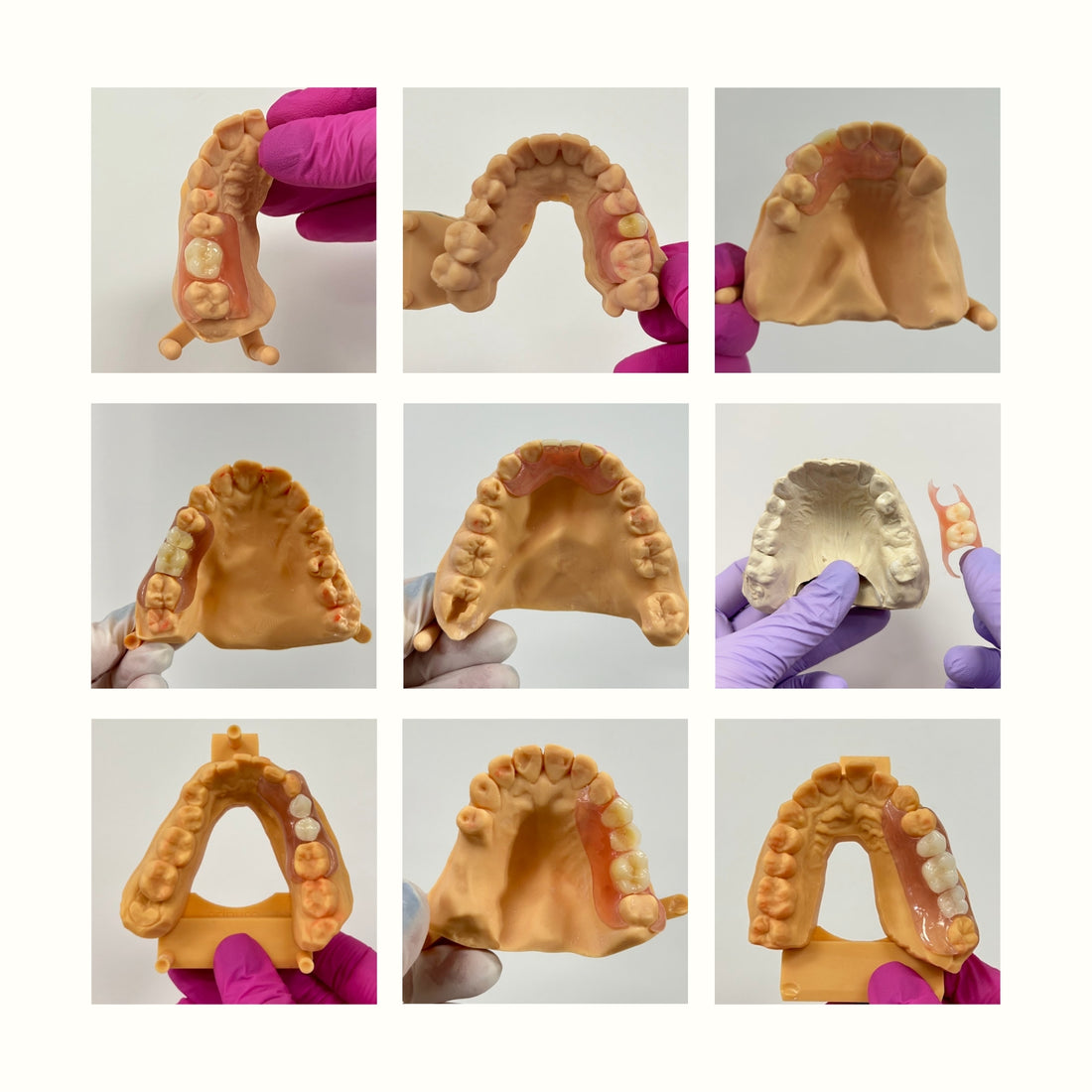
Nothing gets ground down and nothing has to fuse. The appliance rests on the gum and clasps to the teeth still standing, which is why it is available to people a bridge or implant rules out.
The trade is that it is removable rather than permanent, and it comes out at night rather than staying fixed like the other two.
What each route needs from your mouth
| Route | What it needs | Reversible |
|---|---|---|
| Bridge | Healthy teeth on both sides of the gap, ground down to anchor it | No, the anchor teeth are altered permanently |
| Implant | Enough jawbone to hold the post, plus months of healing | No, it is a permanent fixture |
| Partial denture or flipper | Remaining teeth or gum to rest on, nothing altered | Yes, removable any time |
A dentist confirms which route your specific case can support.
How ordering one works
- The impression kit reaches you by USPS in 3 days or FedEx overnight.
- You take the impressions at home and mail them back with the prepaid label.
- A licensed dentist in your state reviews your photos before your kit ships, and a technician checks the impression when it comes back.
- The appliance arrives 14 to 28 days later, made in Hollywood, Florida.
Health account cards are accepted at checkout, and how HSA and FSA payment works covers the receipt your plan will ask for.
Questions people actually ask
Do I need healthy teeth next to the gap for a bridge
Yes. A bridge is anchored on the teeth on either side, and those teeth get ground down to hold the crowns that carry it. If those teeth are not sound, a bridge is not the fit.
What if I do not have enough bone for an implant
Then an implant usually is not a candidate route without a bone graft first, which adds its own healing time. A partial denture or flipper does not depend on bone at all.
Can a partial denture work if a bridge or implant is ruled out
In most cases, yes. It rests on the gum and the teeth you still have rather than requiring bone or grinding down neighboring teeth, which is why it is the fallback that fits almost everyone.
Is a partial denture a downgrade from a bridge or implant
It is a different trade, not a downgrade. You give up permanence and get a route that needs nothing altered or grafted, and one you can stop wearing at any time.
See the two Smile Lab USA builds at the acrylic partial denture and the flexible partial denture. Weighing it against a smaller appliance, read the flipper and partial denture comparison.
Smile Lab USA builds every appliance in Hollywood, Florida, with a 60 day manufacturer warranty on the work.